
Two Singers One Song
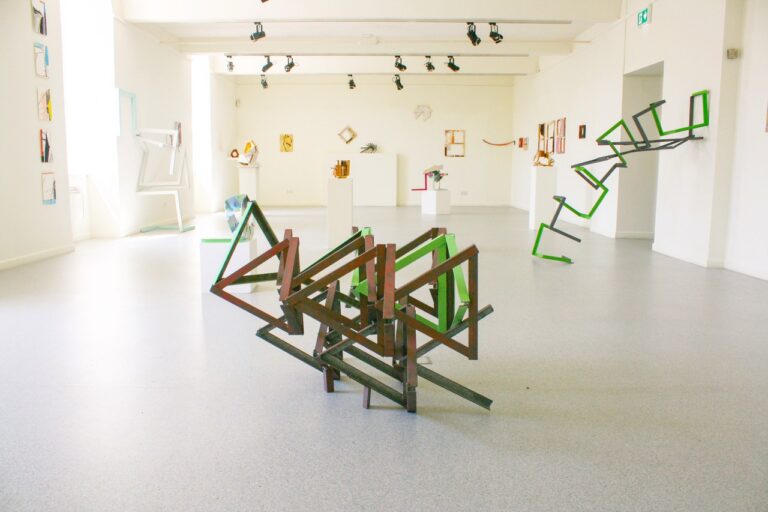
an exhibition of sculpture, painting and drawing
Jackie Askew & Sheila Vollmer
August 6-September 11, 2027
Opening Reception: August 6, 6:00-8:00pm
The Gallery | Burren College of Art
Gallery Hours: Mon-Fri | 9:30am-5:00pm
contact@burrencollege.ie | 065 7077200
Two Singers One Song
Two Singers One Song is an exhibition and artistic collaboration featuring painting and drawing by
Jackie Askew and sculpture by Sheila Vollmer. Grounded in their shared language of abstraction,
the exhibition examines the relationship between their artwork and creative processes: ‘Each of
our respective art practices is distinct in its unique use of abstract construction, made
independently in our studios. Yet, there is a clear sense of harmony in our visual languages that
unites our work’.
Both artists explore fundamental elements of form, line, color, surface, energy, and rhythm.
Through a material-led practice, they express their experiences of space—whether architectural,
poetic, or organic—creating a visual rhythm that guides the viewer in, out, and around their work.
In Two Singers One Song, their vision is to spark dialogue and synergy between their pieces,
connecting them within the gallery space. They aim to invite conversation about how abstract
sculpture and painting communicate through visual language, material, and space, as well as how
they reflect our ever-changing world and personal experiences.
Jackie Askew / Sheila Vollmer – a short history
Jackie Askew (Painter) and Sheila Vollmer (Sculptor) first met at St. Martin’s School of Art,
London in the late 1980’s, both having moved there to study from their home countries of
Ireland and Canada. A strong creative link formed between these two artists and friends,
they went on to establish and work for several years at a studio complex in Forest Hill,
South London, where they continued to explore their shared dialogue of contemporary
abstraction. Currently working in two separate countries they continue to communicate
and exchange similar concerns in their work, often uncovering unexpected parallels in
their approach to abstraction on the occasions when they exhibit and collaborate.
Jackie Askew – lives in Ennistymon, Co. Clare. She has participated in exhibitions in both
Ireland and internationally, receiving many awards, recently from the Arts Council of
Ireland, she has spent time at artist residencies in Ireland, Iceland and Spain. Her work is
held in the public collections of, The Irish Government Office of Public Works / Meath
County Council / Limerick City Council / Civic Theatre Tallaght, as well as private
collections in Ireland and abroad.
Recent exhibitions include: 2025 Abstract Vernacular – Continuing Conversations,
presented by Talking Sculpture, London, U.K; 2025-Two Singers One Song, The Lido
Stores, Margate, U.K; 2024-APT Open Studios, guest artist, Deptford, London; 2024-It
Rose and it Fell, Terrace Gallery, 258 Church Rd, London; 2022/’23-Winter Show, Linden
Hall, Deal, Kent U.K; 2021-The Lido Open, The Lido Stores Gallery, Margate, U.K; 2021-
Dunamaise Open, Dunamaise Arts Centre, Portlaise. 2021 A Generous Space, Hastings
Contemporary, U.K. 2021-Matthew Burrows Selects, Unit 1 Gallery, Bards Rd. London.
2020 – WAY OUT, 80 International artists, La Grange Art Gallery, Cernay-Les- Reims,
France. 2020 The Nearby, three-person exhibition with Sheila Vollmer, Judy O’Sullivan,
KAVA Courthouse Kinvara, Galway. 2020-Winter Open, The Courthouse Gallery,
Ennistymon, Co.Clare.
“My work encompasses painting, drawing, collage and site-specific installation: I find a
personal vocabulary through abstraction by exploring line, structure, and boundaries, as a
response to space and place. Guided by the transformative nature of materials: new
pieces emerge from the destruction, retrieval and reassembly of previous paintings,
where the layers of their history – painted, destroyed, collaged and repainted – are clearly
visible. My recent work focuses on smaller, more intimate pieces using collage, paint, and
soft chalk pastels on paper. I’ve become increasingly engaged with the conversation that
unfolds between small pieces when they are hung together as a group on a wall, creating
installations that when integrated into a space, aim to engage viewers visually and
emotionally. My approach is intuitive: reacting to the process and materials; the work is
open-ended: it evolves organically, each piece freely transitioning into the next as they
evolve and change. Mine is an emotional and reflective process, open to all possibilities
with the hope of finding something surprising and poetic. ” JA.
Sheila Vollmer – based in London works from her studio at A.P.T Studios, Deptford, is
Sculpture Program Manager at Morley College Waterloo London. She has exhibited
widely in the U.K. and has featured in group exhibitions in Ireland, Holland, Taiwan, Germany,
Canada and USA. Recent exhibitions & commissions include ‘Sine Line’, Public
Sculpture Commission, Integral Powertrain Ltd., Milton Keynes. 2024-Thames-Side Studios
Gallery: A Push or a Pull, curated by Alexandra Baraitser. 2024-Reveal, Morley College
Printmaking & Sculpture Staff exhibition, Morley Gallery, London. 2024/’23 Talking
Sculpture: Dialects of Making, TSM (G Brent, A Harley & S Vollmer) @ Vessel Gallery, York
St John University, Exhibition and Symposium with Yorkshire based artists, C Cullen, K
Cowling and H Honeywill, (Symposium guest speaker G Pollock) York. 2023-TSM
presents ‘Still Here –Women Making Abstract Sculpture’ exhibition & discussion, with
guests, A Reading & B Galletley, APT Gallery, Deptford, London. 2023-Colour 2023′
Burghley Sculpture Garden, Burghley House, Stamford, Lincs. 2020-APT Portal Project
solo gallery window exhibit, APT Gallery. 2021; Artist of the Day (solo show), Flowers Gallery
Central, London SE1 2015-The Atrium Gallery, Cooper’s & Lybrand, London WC1.
“my sculpture practice explores line, form and space, using steel, wooden skirting board
and more recently tinted perspex, with references to architecture, natural systems, and
the body’s relationship to these. My working method responds directly to the material
and the space, constructing sculpture in a modular rhythm of replicated and changing
units, both opening and containing space, searching to express the inside/outside pull of
energy and emotion. Added colour accentuates the inside/outside of the lines, forms and
negative spaces creating rhythm and energy to the ever-changing views.” SV.
https://www.instagram.com/two_singers_one_song/
https://www.instagram.com/jackieaskew_painting/
https://www.instagram.com/sheilavollmer/
http://www.sheilavollmer.com
https://www.aptstudios.org/sheila-vollmer
https://sculptors.org.uk/artists/sheila-vollmer
Essay by Cherry Smyth
In a recent essay called ‘Notes on Shape’, painter Amy Sillman, argues that ‘shapes are kind of like sculptures that sit inside paintings.’ (1) It got me thinking if paintings could also sit inside sculptures. And what would that look like? In this show of work by Jackie Askew and Sheila Vollmer, two artists re-situate painting beside sculpture, re-invigorating both, as if they have sat inside each other’s work. Sillman goes on to say that in the last fifty years of the 20th century, what she calls ‘the process of tinkering with shapes’ went out of favour in the excitement of embracing grid systems and technology. ‘I love shapes,’ she says,’ for their anachronism, their permissiveness, their ill-fittingness.’ (1)
In times of digital hyper-creativity, video slickness and AI super-mastery, why return to an analogue tension between materials and shape? As our own bodies start to feel anachronistic, unable to speak out and jutting awkwardly, surely work that investigates vulnerability and provisionality will help us adapt to this algorithmic stream we can no longer swim against. While Sheila Vollmer takes industrial materials made for strength and function and repurposes them in ways that undermine their usefulness, Jackie Askew smashes the flatness of the traditional 2D painterly surface to reveal the 3D elements behind and within it. As Jackie says, ‘Vulnerability comes from the potential disaster that is always there.’
Both thematically and methodologically, the two artists, as the title of the show, ‘Two Singers One Song’, suggests, align more than at first meets the eye. Both defy the traditional limits of materiality: Jackie by over-riding the picture frame and exposing the canvas stretcher, and Sheila by conjoining steel into shapes it never saw coming. As Sheila says, ‘My work is about nothing and about everything and discovering things through materials. Part of that process is listening to jazz.’ Both refute solidity and fixity by playing with precarious balance, like Sheila, or by destroying previous paintings and collaging them into new configurations, like Jackie. Defiance unites their practices. Take what I call Sheila’s ‘catastrophic staircase’ in green and charcoal – an architectural fixture that has come undone, been contorted and distorted and yet still ascends. We recognise the absurdity of its pose, just as we recognise our camouflages of vanity, our horror of ageing. It recalls for me, the footage of an elderly ballerina who suffers from dementia, but whose frail body can still remember the ballet steps when the music plays and some youth and grace return. There’s something magical and newly resilient in the beauty Sheila creates that the hard lines of steel never expected. To remain upright, even jaunty, amid entropy and collapse, is an act of both resistance and celebration.
For Jackie, defiance shows in the hacked into, fragmented scraps of previous paintings that question their own purpose as they droop like pointless flags or hang in strips, painted in colours of mud and sand, like something trying to hide, to disguise itself. Where does the painting begin and end? When does meaning erupt and fall away? I was surprised when Jackie once told me that she doesn’t necessarily see her work as abstract. ‘I can’t get away from the feel of the figure,’ she explains. I’m reminded of what painter Magalie Guerin says, ‘I don’t think of my work as abstract. I do abstract a form that has its origin in the physical world, yes, but the new shape becomes the original. Its reality is the only reality.’ (2) Jackie’s ruptured work hangs by a thread of what could be called integrity, a wholeness we cannot see but can feel. Our eyes seek to make the painting whole, include the wall behind it and the compromised, daubed edges of its frame. In this, Jackie asks us to step into risk, into danger, to look at the tatters, to shiver in the cold, to experience the loss of shelter, the uncertainty and lasting damage. I’d like to quote from Angela Gardner’s poem, ‘Not Thinking About the Circus at the Circus’:
‘It all hangs on the tethered wrist
or ankle: the idea of the real, companion to that personal copy we each
separately hold. That interval between possible worlds, the hinge
it all hangs from.’ (3)
Is it possible to stay with the shreds, Jackie asks. To cling as they cling to what teeters on the irreparable. This is painting as resistance, as protest, working against collapse. By refusing to adhere to paintings of ‘good taste’, that represent ‘warm safety’, she wrecks the framing of her own well-educated sensibility and thus reflects a wider field of wreckage of killing, of grief, land robbery and displacement. It’s only our gaze that can provide replacement, some measure of recuperation.
Sheila’s work also deals with resilience in the face of collapse. One sculpture resembles a jagged jumble of climbing letters in an alphabet we don’t know. We make an effort to read it, fail and begin to accept its strangeness. I speak of language to ascertain what these objects want to say. What are they holding on to? The wall, the floor, or each other? A blue square metal ‘painting’ has broken away from the wall into a sculptural line of grey that twists rhythmically back into a blue frame on the ground. What seems inflexible opens up new flexibilities in the mind. Here is a problem trying to solve itself, like logic applied to honey. In another of Sheila’s sculptures, a black water wheel or giant cog appears as something mechanical but can’t move or be moved, like a Filofax operated by an iPhone. Elsewhere, remnants of a lost industrial age – stacked, rusted metal struts – relish their uselessness with an insert of lime green, triangular joy. Sheila’s work explores the awkward and even comic pleasure of redundancy. Through challenging obsolescence, these sculptures emit the energy of reinvention, innovation and the bold adaptability of surprise.
- Amy Sillman, Zine made for ‘Landline’ at Camden Arts Centre, London, Sept 2018 – Jan 2019
- Magalie Guerin, Notes On, The Green Lantern Press: Chicago, 2019, p.91
- Angela Gardner, Some Sketchy Notes on Matter, Recent Work Press: Canberra, 2020, p.57